
You’ve rubbed it, cracked it, stretched it over the back of a chair until something almost gave. None of it lasts. An hour later you’re right back to that same tight band running across the base of your neck. The problem isn’t your pillow, your posture, or your desk setup — it’s something none of those fixes were ever built to reach.
Here’s the part nobody tells you: most of what you’ve been doing isn’t treating your neck pain. It’s masking it.
Masking vs. Repairing: What’s Actually Different
Heat, massage, the occasional over-the-counter pill — they all do the same basic thing. They turn the volume down on what you’re feeling for a little while. None of them change what’s actually happening in the tissue, which is why the tightness always finds its way back to the exact same spot by the next afternoon.
Your neck carries a strange amount of load for how little most people think about it. Hours hunched over a laptop, a phone tilted down for texts, a long drive with your head locked in one position — it all adds up across both sides of your neck, usually unevenly. One side tightens up more than the other, and that imbalance is exactly why rubbing the sore spot never quite finishes the job.
Why a Dual-Zone TENS Unit for Neck Pain Changes the Equation
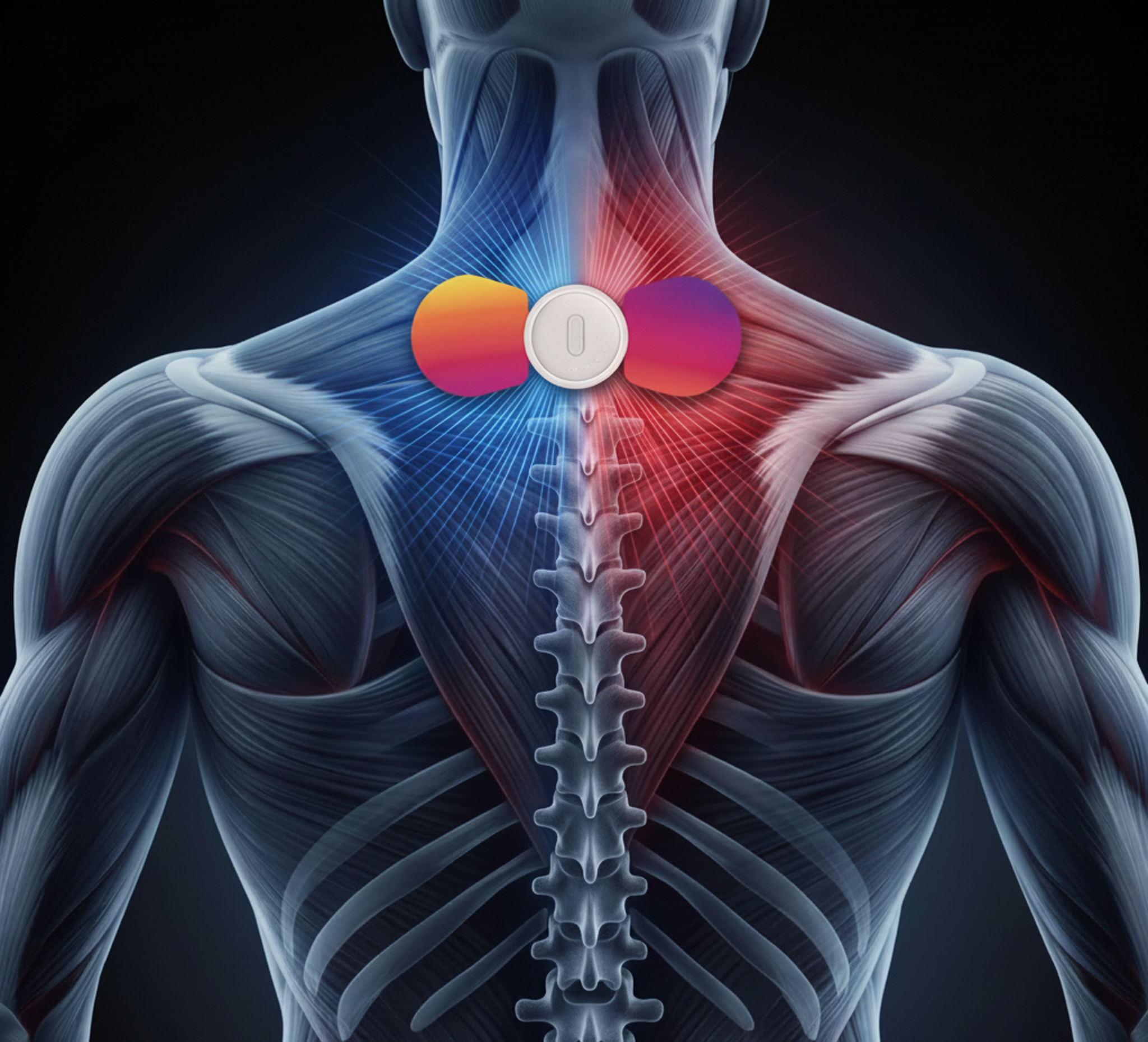
This is where a wearable TENS device for neck pain works differently than anything you’ve tried with your hands. A unit built for dual-zone stimulation doesn’t just hit one sore patch — it targets both sides of your neck at the same time, because your neck pain almost never lives on just one side, even when that’s where you feel it most.
A TENS unit for neck pain works by sending small electrical signals through your skin that interrupt the pain signals trying to reach your brain, while also helping your body release its own natural pain-fighting chemicals. You’re not numbing the area from the outside in — you’re working with your own nervous system, the part heat and massage were never able to touch in the first place.
Built for an Actual Neck, Not Just a Diagram of One
Most wearable TENS units assume your neck is a flat surface. It isn’t. Here’s what actually matters in the design:
Rotating, ultra-flexible wings — full 360-degree movement lets the pads sit against the real curve of your neck instead of fighting it, for consistent contact whether you’re at your desk or lying down.
Wireless, app-controlled operation — no wall outlet, no cord limiting how you move while it runs.
Customizable programs — switch between settings built for different pain conditions, and dial in intensity from your phone instead of fumbling with a unit strapped to your neck.
Progress tracking — see your results session over session instead of guessing whether it’s actually working.
What This Looks Like for You
You put it on. You open the app, pick the program, and dial in the intensity until it feels right — not painful, not too mild to notice. Then you go back to your day: emails, the drive home, the meeting that always lines up with your worst afternoon slump. The device runs in the background, on both sides of your neck at once, for as long as you need it.
Over time, you’re not just covering up the tightness for an hour. You’re giving your nervous system a real chance to stop sending the signal that’s been keeping that area locked down in the first place.
The Bottom Line
Rubbing your neck and hoping it loosens up is masking the problem. A wireless, app-controlled TENS device built for dual-zone relief is the first thing most people try that actually works with their nervous system instead of around it.
Stop masking it. Start repairing it.
Leave a Reply